

Native Dry Meadow Design Toolkit
A toolkit to create a native prairie garden planting plan for dry sites, so your planting looks intentional and thrives through time
Instant digital download (PDF). Download link sent by email after purchase.
At a Glance
Format: 8.5" × 11" PDF digital download
Length: 76 pages — a complete set of decision-making tools including visual references, charts, plant profiles, and a quantity calculator that solve layout and plant-count uncertainty
Best for: design-minded gardeners and landscape professionals planning dry meadows who want a clear framework for coherent composition and species selection
You’ll get: a plant palette based on plant function, a structured layout method you can adapt to your planting area, and realistic starting plant counts per species
PolyFlora Pathway™ phase: Design (1 of 4)
Build a Prairie Garden Planting Plan

This Toolkit provides a refined 16-species dry meadow plant palette with species alternatives; plan, section, and 3D reference pages; and practical tools that support confident meadow garden design decisions. Built for prairie constraints including hot summers, cold winters, and shifting plant availability, the Toolkit is more than a plant list. You will discover a design framework that is based on understanding plant roles and plant layering, which takes the guesswork out of planning your meadow.
Visual references show you how to compose your planting, and the quantity calculations with density and spacing guidance help you estimate realistic plant counts per species. Recommendations on plants per square metre provide a practical starting range, so you can move forward with growing or sourcing plants for your planting area.
How It Works

This Toolkit is designed to solve three common sticking points:
Composition uncertainty — difficulty picturing how a meadow should be arranged in your space
Species uncertainty — guessing which plants belong in a dry meadow and which choices are best
Quantity uncertainty — difficulty determining how many plants will be enough for your space
Use the Toolkit in a clear sequence:
Define your meadow area. Confirm what a designed dry meadow needs, then set a realistic footprint.
Choose species by role. Build a plant palette from the core set of species and their substitutes based on your goals and plant availability.
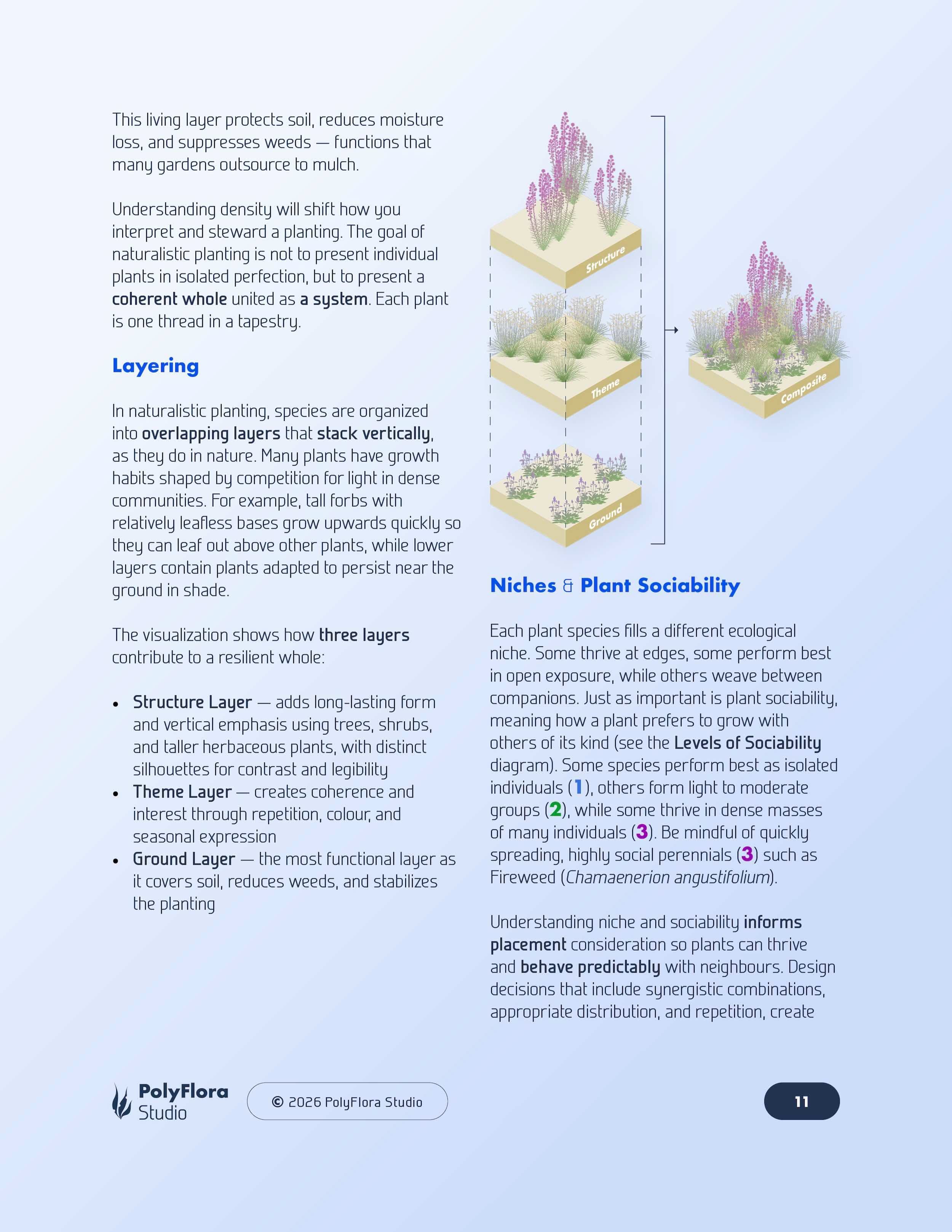
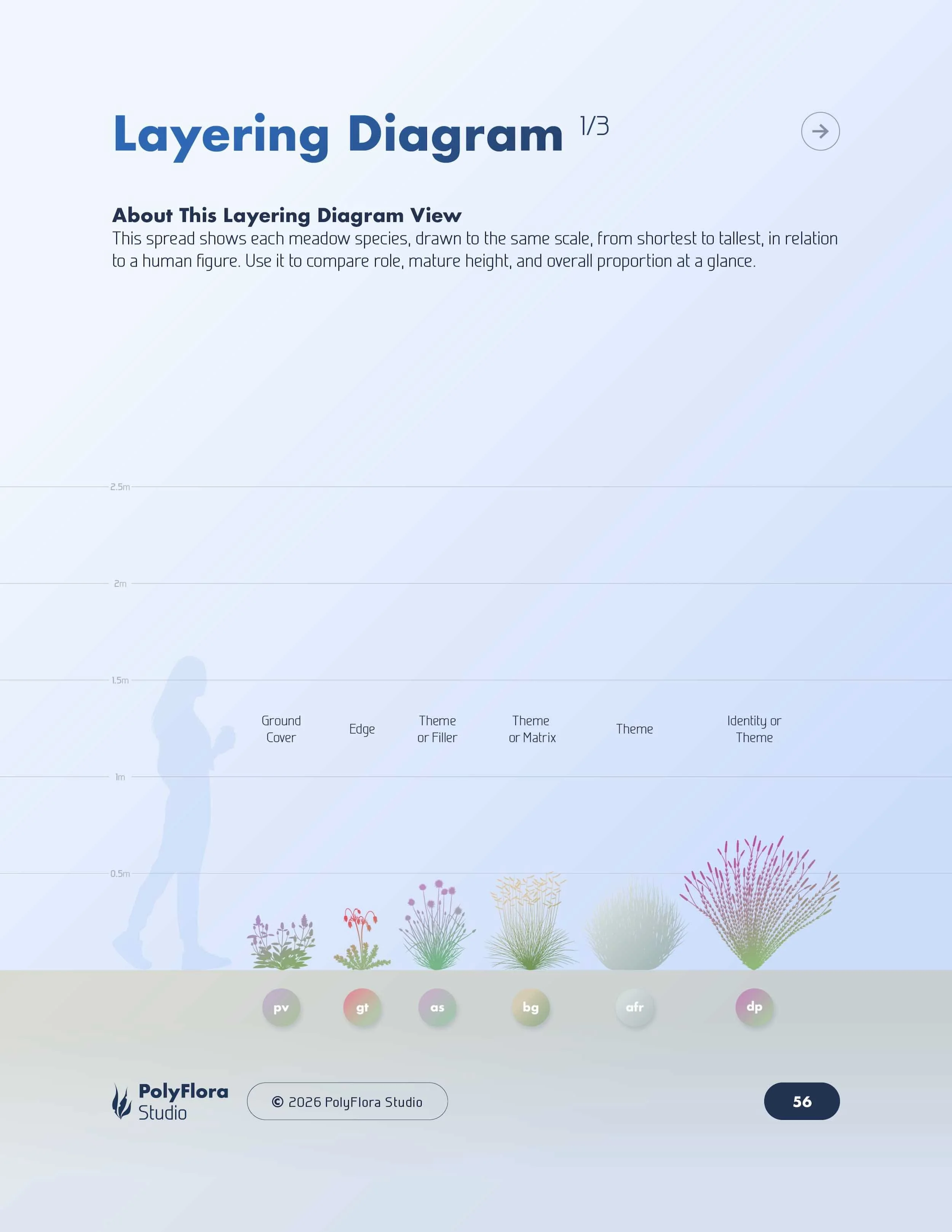
Visualise the outcome. Learn how plant layers work together and use section and 3D views (axonometric) to confirm height, density, and seasonal structure.
Plan the layout. Adapt plan views to your space and place plants according to their behaviour and compatibility while considering various bed widths and shapes.
Estimate realistic starting quantities. Use density and spacing guidance to generate a realistic plants per square metre target and quantities per species for propagation or sourcing.
Example of a plant substitution based on roles:
Defining plants based on their roles lets you substitute plants without breaking the composition. For example, both Selfheal (Prunella vulgaris) and Wild Strawberry (Fragaria virginiana) are defined as ground covers because they are short spreaders that fill gaps and cover soil. You can swap one for the other and maintain similar ground coverage.
Why It Matters

If you feel stuck because you cannot picture how a dry meadow should come together in your space, this Toolkit will get you started.
Meadow-style gardens often disappoint for reasons that have nothing to do with whether the plants are right. The issue is usually the plan. Without a design framework, even good plants can form an incoherent mix that never quite reads as intentional.
This Toolkit helps you avoid three common failures:
Visual incoherence — an assortment of plants without an intentional composition
Unnecessary fussing — mismatched behaviours and missing ground coverage create more work than expected
Missed opportunities — not choosing the best species for particular locations and conditions
Planning with plant layers and plant roles in mind turns a plant list into a living fabric. Dense, layered plantings form a plant community that closes gaps, stabilises the ground layer, and becomes more self-sustaining over time. The planting remains coherent as it matures, and supports a lower-input garden shaped by occasional, thoughtful edits. It reads as intentional early and becomes richer, not messier, over time.
What’s Inside

A complete set of understandable and usable planning tools for native dry meadow design:
Dry meadow essentials — a concise set of core principles and practical notes that define what a designed meadow needs for long-term success
Role-based plant selection — nine role definitions with selection guidance and substitution cautions
Species palette — a refined 16-species set with role-based alternatives (25 substitution options)
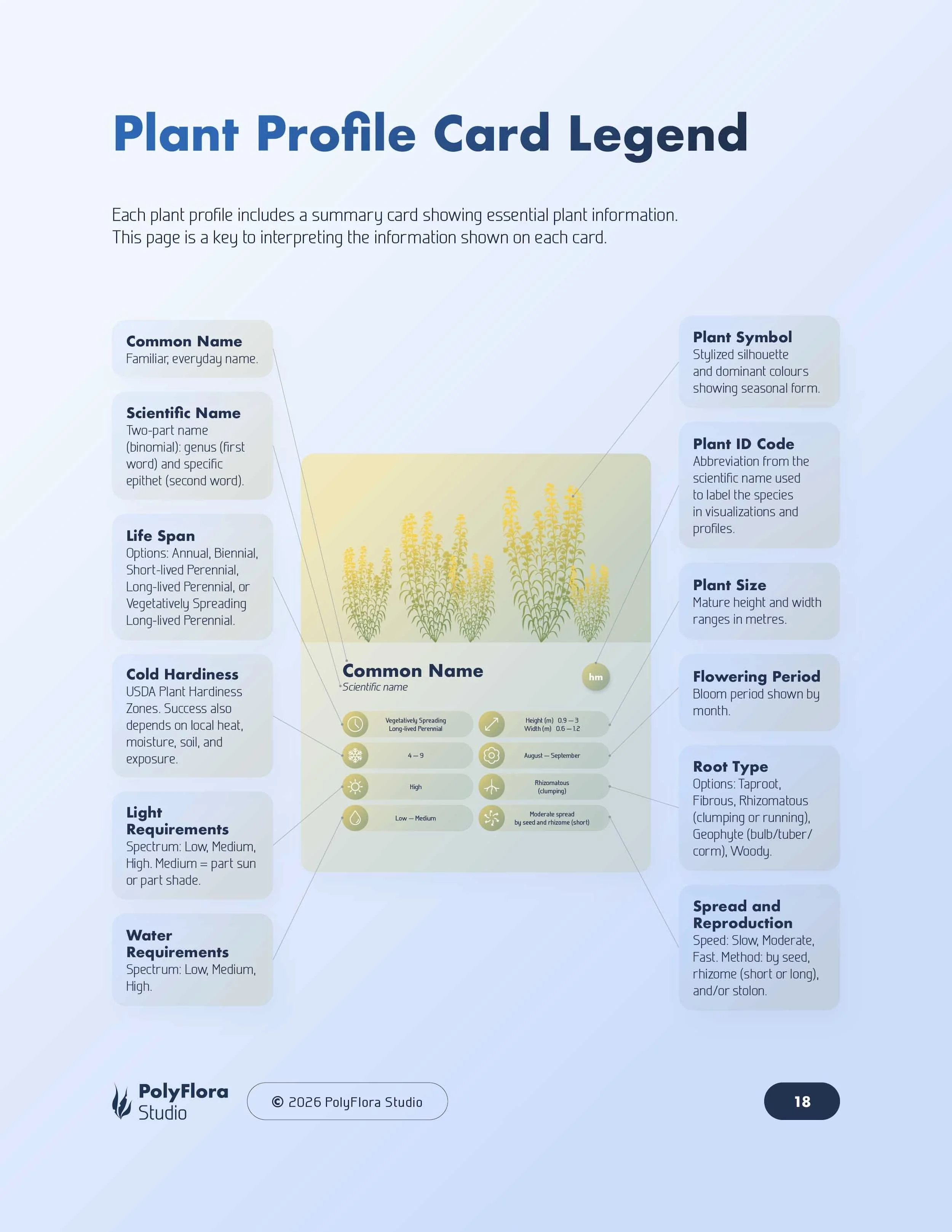
Plant profiles — performance-focused profiles with photographs, placement sequence, and key decision fields (lifespan, spread mode, spread rate, size range, and site fit)
Seasonal appearance overview — a phenology chart showing seasonal timing for all species
Visual planning pages — plan, section, and 3D views (axonometric) with notes for adapting layout to different bed widths and shapes
Spacing, density, and quantity references — per-species spacing and recommended plants per square metre, plus an easy to follow calculation process to generate realistic plant counts for each species
Completed quantity table — an example with precise plant counts per species for a 300m² meadow
How to Use This Toolkit — a quick guide to the planning sequence and how the pages work together
Visual Preview
A few representative pages so you can assess the structure, visual system, and level of detail before purchasing.
-
Structure / Theme / Ground
-
How to read the profiles
-
Height and vertical structure
-
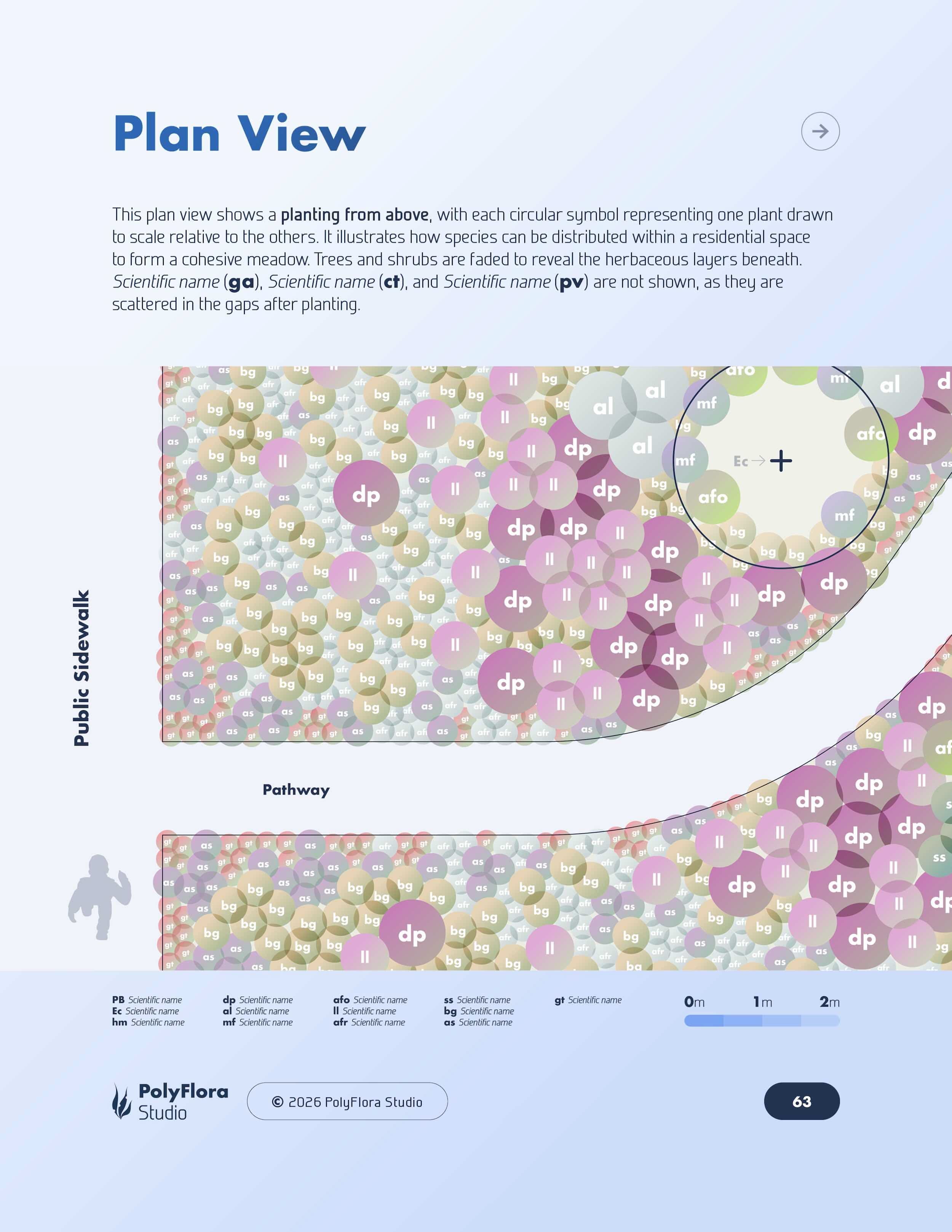
Role-based distribution (plan view)
-
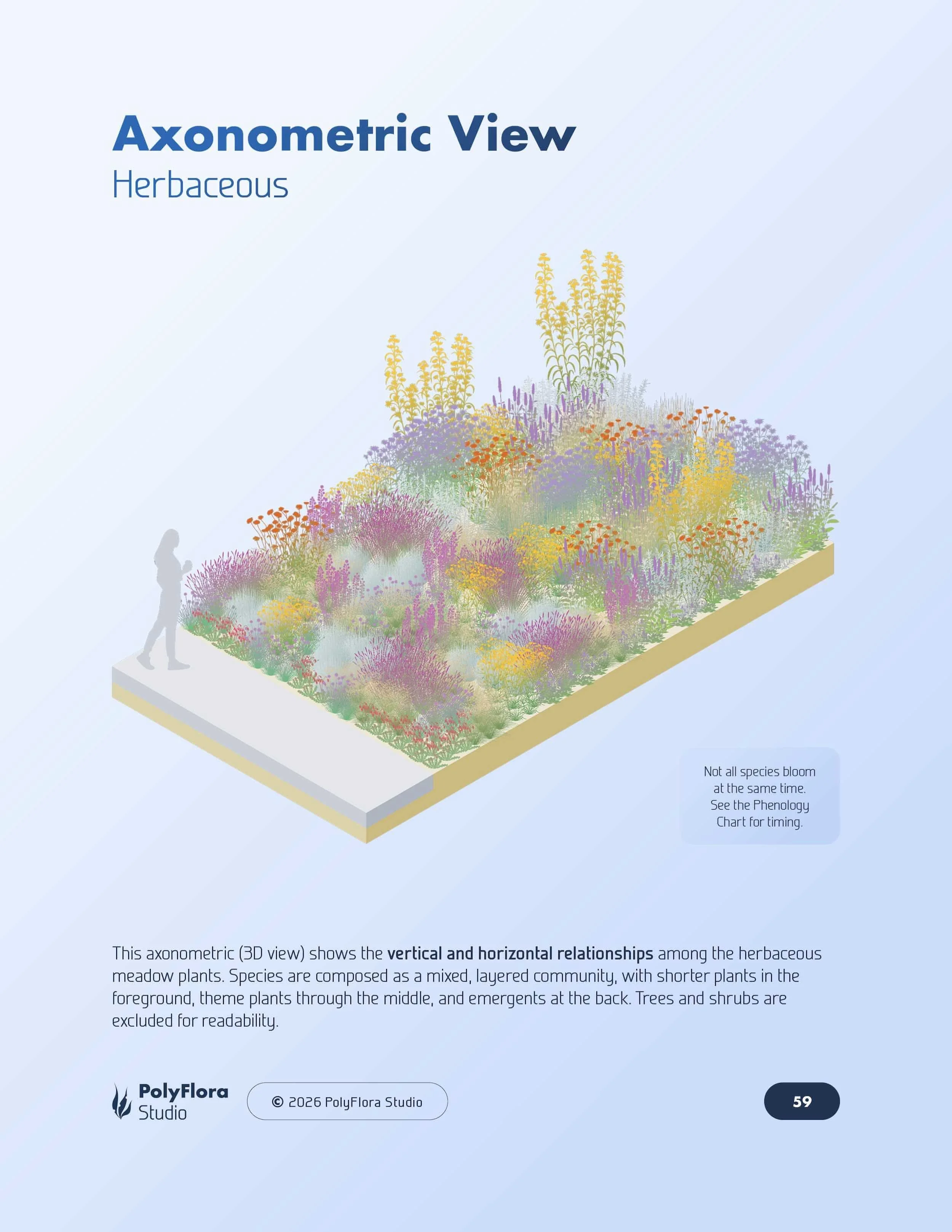
Composition and density at a glance
Before You Buy

This is for you if you want:
A clear method for planning a native dry meadow by choosing plants that are compatible
A planting that reads as intentional and legible, with season-long interest as it changes
The design logic behind naturalistic planting and designed meadows, so your decisions feel justified and coherent
A structured way to plan confidently on your own, with clear decision-making tools instead of guesswork
This is NOT for you if you want:
A custom planting plan made for your property
Detailed propagation guidance for each species
Detailed site preparation instructions
Step-by-step planting instructions
Comprehensive stewardship instructions after planting
How you’ll use it:
Define your meadow area and constraints
Build a role-based plant palette and adapt a layered layout
Calculate starting plant quantities for sourcing or growing
Make It Yours
A planning system for meadow garden design on dry sites that turns a native plant palette into a coherent layout with realistic plant counts so your planting looks intentional and performs well over time.
Designed to save weeks of research, reduce costly plant mistakes and help you develop a meadow garden with confidence.
Instant PDF download
$197
Instant digital download (PDF). Download link sent by email after purchase.
Details
-
PDF digital download
Page size: 8.5” × 11” (letter)
Length: 76 pages
-
Instant PDF download. You will receive an email with your download link after purchase.
-
Due to the digital nature of this product, all sales are final.
If you experience any download issues, we’ll ensure you receive your copy.
-
This product does not include one-on-one feedback or project guidance. Support is limited to download and access issues. If you need site-specific direction, explore consultation options. For file access help, contact nathaniel@polyflorastudio.ca
-
The dry meadow palette is based on Alberta prairie plant communities. Outside similar prairie or steppe regions, use it as a guide and substitute species by role to align with local native ranges. When substituting, confirm regional native ranges for your area first.
-
Hardiness is listed on each plant profile using the United States Department of Agriculture (USDA) cold hardiness zones (based on average annual extreme minimum winter temperature). Across the 16-species palette, all plants will grow in USDA Zones 4-8; most will grow in USDA Zones 3-8. Note that the Canadian Plant Hardiness Zones is a different system and numbered ratings do not directly translate.
PolyFlora Pathway™

A full-sequence planting design process that connects design, procurement, planting, and stewardship for long-term performance. The PolyFlora Pathway™ shows how each phase fits together so your garden thrives over time.
Continue Exploring

Explore more digital guides and planting design toolkits that help you plan, plant, and sustain gardens with confidence.